Mathematics, Quantum & AI Research
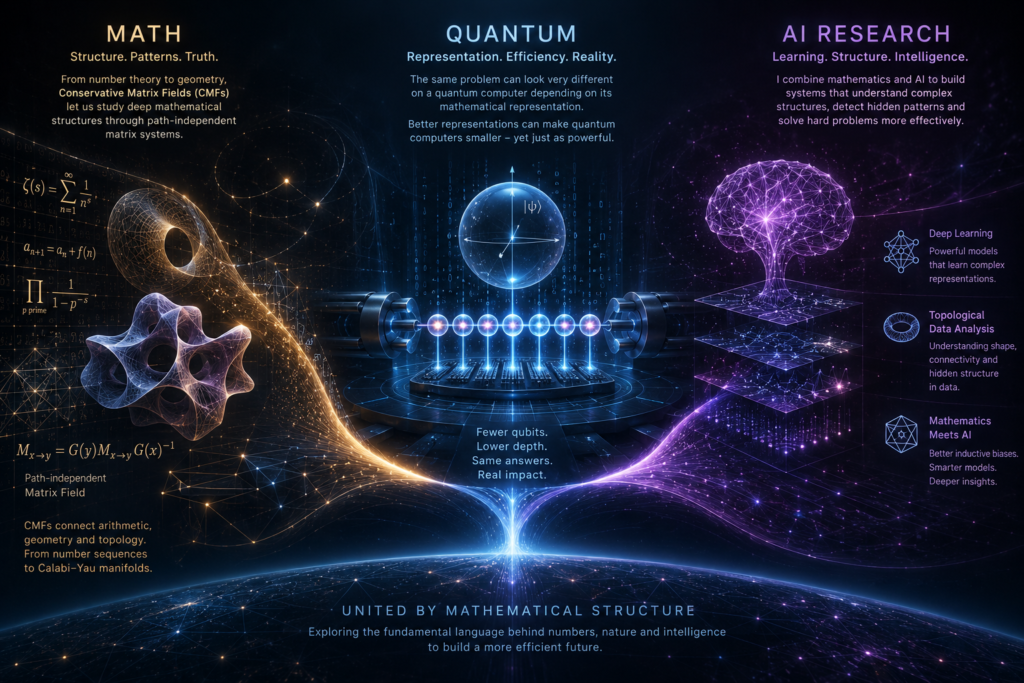
My research sits at the intersection of mathematics, quantum computing and artificial intelligence, with a common goal: understanding how mathematical structure can make complex computational problems more efficient, interpretable and tractable.
Mathematics
A central part of my work is in number theory, special functions and Conservative Matrix Fields (CMFs).
CMFs are path-independent matrix systems defined on discrete lattices. Their key property is that different paths through the lattice can encode the same global mathematical information. This creates a powerful framework for studying structure, invariants and transformations across very different areas of mathematics.
I use these ideas to investigate problems ranging from number sequences, continued fractions and mathematical constants to more geometric objects such as elliptic curves and Calabi–Yau varieties.
The broader question is whether path-independent matrix fields can serve as a common language for connecting arithmetic, geometry and discrete dynamical systems.
Quantum Computing
My quantum research focuses on a simple but fundamental question:
Can better mathematical representations allow quantum computers to solve the same problems with fewer computational resources?
Quantum algorithms depend not only on the underlying problem, but also on how that problem is represented, encoded and compiled into a quantum circuit.
I am studying whether mathematically equivalent formulations can lead to very different requirements in terms of qubits, circuit depth, gate complexity and measurement efficiency.
The long-term idea is that mathematical structure, symmetry and better representations may help us build quantum algorithms that extract more useful computation from smaller quantum systems.
In other words, progress in quantum computing may come not only from building larger machines, but also from finding ways to need fewer qubits in the first place.
AI Research
My AI research combines mathematics and machine learning to develop systems that are better at reasoning over highly structured and complex problems.
I work with methods including deep learning, geometric learning and topological data analysis, with a particular interest in models that can exploit mathematical structure rather than relying purely on scale.
The broader goal is to explore whether explicit mathematical information, such as geometry, topology, symmetry and algebraic structure, can help AI systems become more efficient, more robust and better at solving difficult scientific and computational problems.
Several of these projects are ongoing and not yet public.